Showing posts with label Culture. Show all posts
Tuesday, 28 May 2013
"Voluntourism" in Chiang Rai, Thailand
What is "Voluntourism"?
"Voluntourism" is an emerging trend in the tourism industry, and it has been growing in recent years. Visitors who go for voluntourism want to explore a slice of tourism beyond the traditional, cliche means of leisure and entertainment - they want to give a part of themselves back to the host community/country. It is a type of tourism that allows total involvement and to make an sustainable impact on the lives of the local people, culture, traditions and environment.
Community Development for Hill Tribes and Children
Helping the hill tribes in Chiang Rai, Thailand is a golden opportunity for voluntourists to lend a hand. Hands-on work such as working with nature, agriculture, construction, and teaching children can help improve the lives of the Akha minority tribe, especially among younger children.
This Volunteer Project and activities are part of a joint effort between ISV Foundation Thailand and the Mae Kok Foundation. The ultimate goal is to improve the life of underprivileged children by providing housing, food, education and other vocational training to them.
The training activities which the volunteers will perform with them include improving agricultural knowledge and working skills in the areas of vegetable gardening, welding, building and embroidery, as a way to provide the children with better opportunities for their future independence and livelihood.
Volunteers will be involved in teaching English and running an English camp for a variety of children with different levels of English knowledge. Volunteer teams will spend time preparing lessons and teaching English-speaking and listening skills to primary school aged children using informal approaches, such as activities and games.
Additional daily activities will include: manual labor around the foundation, assisting with preparation and cleanup before and after meals, and attending vocational and artistic workshops, such as embroidery, as a way to enhance life experience at Mae Kok Foundation.
As usual, there are many exciting, rewarding, and educational leisure activities available to the volunteers during their time off including: Visiting the children’s families at a local Akha village; exploring local hot springs and waterfalls; and walking through local tea plantations where some of the children’s families work.
Please go to www.thelittlebigprojectthailand.com to learn more about this very special project and other voluntourism projects supported by the TAT.
Article written by Tourism Authority of Thailand. Pictures by Tourism Authority of Thailand. Credits to Tourism Authority of Thailand.
Monday, 13 May 2013
Malaysia Homestay Programme – Life in the Country
If you want a break away from the hustle and bustle of city life, don't head for the beach immediately. There are many other choices besides sun, sand and sea vacations. To see how locals truly live, you need to know and appreciate their culture and heritage.
By participating in the Malaysia Homestay Programme, visitors will take part in activities such like plucking tropical fruits in an orchard and learn to play a traditional musical instrument or the steps to a cultural dance.Other interesting pursuits include harvesting local crops, visiting a fish farm, and indulging in traditional pastimes such as kite-flying and top spinning. The locals might stage a mock-wedding that showcases the local customs and rituals especially for visitors.
The Malaysia Homestay Programme which won the World Tourism Organization (UNWTO) 2012 Ulysses Award for Innovation in Public Policy and Governance enables tourists to experience kampung village lifestyle, culture, agriculture and cuisine. This programme is a good opportunity for children to find out a side of life that they do not get to experience - waking up to the call of birds early in the morning and playing traditional games like top-spinning - things that are different from the city life that they are used to.
Tourists will live with a local family throughout their stay in the programme. There are homestays available in every state of the country.
The Banghuris, Sungai Sireh and Sungai Haji Dorani homestays for instance, are situated only an hour’s drive from Kuala Lumpur, Malaysia’s capital city.
Visitors to Kampung Pelegong in Negeri Sembilan can savour tropical fruits freshly plucked from the orchard, while a stay at Kampung Seri Tanjung, Melaka, enables visitors to make a trip to the many Dutch and Portuguese historical landmarks there.
For a taste of island life, visitors can head to the Desa Wang Tok Rendong and Pulau Tuba homestays in Langkawi. Cottage industries such as batik-painting and songket-weaving are commonly found at homestays in the east coast states of Kelantan and Terengganu.
Experience genuine Malaysian warmth and let the homespun hospitality work its charm!
Article from Tourism Malaysia. 2012. For more information about this article, click HERE. All credits to Tourism Malaysia.
By participating in the Malaysia Homestay Programme, visitors will take part in activities such like plucking tropical fruits in an orchard and learn to play a traditional musical instrument or the steps to a cultural dance.Other interesting pursuits include harvesting local crops, visiting a fish farm, and indulging in traditional pastimes such as kite-flying and top spinning. The locals might stage a mock-wedding that showcases the local customs and rituals especially for visitors.
The Malaysia Homestay Programme which won the World Tourism Organization (UNWTO) 2012 Ulysses Award for Innovation in Public Policy and Governance enables tourists to experience kampung village lifestyle, culture, agriculture and cuisine. This programme is a good opportunity for children to find out a side of life that they do not get to experience - waking up to the call of birds early in the morning and playing traditional games like top-spinning - things that are different from the city life that they are used to.
Tourists will live with a local family throughout their stay in the programme. There are homestays available in every state of the country.
The Banghuris, Sungai Sireh and Sungai Haji Dorani homestays for instance, are situated only an hour’s drive from Kuala Lumpur, Malaysia’s capital city.
Visitors to Kampung Pelegong in Negeri Sembilan can savour tropical fruits freshly plucked from the orchard, while a stay at Kampung Seri Tanjung, Melaka, enables visitors to make a trip to the many Dutch and Portuguese historical landmarks there.
For a taste of island life, visitors can head to the Desa Wang Tok Rendong and Pulau Tuba homestays in Langkawi. Cottage industries such as batik-painting and songket-weaving are commonly found at homestays in the east coast states of Kelantan and Terengganu.
Experience genuine Malaysian warmth and let the homespun hospitality work its charm!
Article from Tourism Malaysia. 2012. For more information about this article, click HERE. All credits to Tourism Malaysia.
Wednesday, 8 May 2013
Spring in Thailand Means Loads of Summertime Fun
In fun-loving Thailand, even the seasons are vulnerable to a little bit of sanook.
While most people consider April as the showery middle of springtime,
here in the Land of Smiles it’s called summer. School’s out, the heat
cranks up, and so do the opportunities to enjoy a happy vacation.
Any account of the Siamese summer would be lacking if it didn’t mention Songkran, the Thai New Year festival marking the traditional calendar’s “astrological passage”, which is celebrated by dousing with water anyone within splashing range. Observed nationwide during the hottest part of the year, the holiday is famous for people wandering the streets carrying containers of water or water guns like dripping-wet soldiers, or simply settling themselves down at the sides of roads and intersections with buckets and garden hoses, soaking each other and passersby with glee.
If wet and wild is your idea of a good time, then this time of year is
perfect for visiting any of Thailand’s seemingly endless selection of
beautiful beaches. Phuket is the world-renowned resort
destination where holiday-goers can relax amid picturesque white sand
beauty, head out on the crystal clear Andaman Sea for a snorkel or scuba
trip, and enjoy a seemingly limitless array of great food and
nightlife. The best thing about the early summer months in the islands,
April and May, is that it’s the “low season” for visitors from many
Western countries. Hotels and restaurants run promotions and things
tend to be a bit cheaper and less crowded. But shhhhhhh, that’s between
you and me.
For an even more laid-back beach experience in low season, head to another Andaman island, Ko Lanta. The reduced number of travellers visiting there in summer means they are rewarded with long stretches of beach to themselves and the serenity of an uncrowded island paradise, and while the island 'slows down' around the end of April each year because of the oncoming green season, it is possible to enjoy weeks at a time with little or no rain. Roughly 80% of the population there practices Islam, and fishing and chilling on the beach are a way of life. Due to this Muslim influence, the local cuisine is based firmly in Malay and Indian traditions. Local favourites include southern-style dishes like Muslim curry (massaman), rice noodles in fish curry sauce (khanom chin), and chicken birayani (chicken on yellow curried rice). A distinctive Southern dialect of Thai is spoken there, and the Old Lanta Town is rich in history, local customs, and traditional festivals.
A popular summertime activity in Thailand is the Chiang Mai Night Safari, one of only a handful of nature parks of its kind, and a unique sight for people of all ages. Many travellers familiar with this type of theme park consider Chiang Mai’s the most beautiful Night Safari in the world, plus, in summer, any nighttime excursion offers a welcome respite from the daytime weather. The Night Safari is basically an aesthetically pleasing zoo set out like a theme park, with the animal viewing separated into three main areas: the Jaguar Trail, featuring a 1.2km walking trail which provides glimpses of a wide variety of exotic mammals and birds; the Savanna Safari and its 300+ animals covering everything from white rhinos to kangaroos; and the Predator Prowl, where the big hunters roam.
For those looking for big-city action, you can beat the heat by sampling Bangkok's superlative selection of A/C-chilled shopping malls. All the leading international brands are available in places like Siam Paragon and Gaysorn Plaza, which emphasize fashionable luxury living and host a wide selection of registered dealers of top names like Gucci, Louis Vuitton and Tiffany, among others. In nearby Ratchaprasong, the Central World and Central Chitlom malls provide an oasis with the former hosting nearly 500 shops which are highly popular among affluent Thais and expats.
Any account of the Siamese summer would be lacking if it didn’t mention Songkran, the Thai New Year festival marking the traditional calendar’s “astrological passage”, which is celebrated by dousing with water anyone within splashing range. Observed nationwide during the hottest part of the year, the holiday is famous for people wandering the streets carrying containers of water or water guns like dripping-wet soldiers, or simply settling themselves down at the sides of roads and intersections with buckets and garden hoses, soaking each other and passersby with glee.
For an even more laid-back beach experience in low season, head to another Andaman island, Ko Lanta. The reduced number of travellers visiting there in summer means they are rewarded with long stretches of beach to themselves and the serenity of an uncrowded island paradise, and while the island 'slows down' around the end of April each year because of the oncoming green season, it is possible to enjoy weeks at a time with little or no rain. Roughly 80% of the population there practices Islam, and fishing and chilling on the beach are a way of life. Due to this Muslim influence, the local cuisine is based firmly in Malay and Indian traditions. Local favourites include southern-style dishes like Muslim curry (massaman), rice noodles in fish curry sauce (khanom chin), and chicken birayani (chicken on yellow curried rice). A distinctive Southern dialect of Thai is spoken there, and the Old Lanta Town is rich in history, local customs, and traditional festivals.
A popular summertime activity in Thailand is the Chiang Mai Night Safari, one of only a handful of nature parks of its kind, and a unique sight for people of all ages. Many travellers familiar with this type of theme park consider Chiang Mai’s the most beautiful Night Safari in the world, plus, in summer, any nighttime excursion offers a welcome respite from the daytime weather. The Night Safari is basically an aesthetically pleasing zoo set out like a theme park, with the animal viewing separated into three main areas: the Jaguar Trail, featuring a 1.2km walking trail which provides glimpses of a wide variety of exotic mammals and birds; the Savanna Safari and its 300+ animals covering everything from white rhinos to kangaroos; and the Predator Prowl, where the big hunters roam.
For those looking for big-city action, you can beat the heat by sampling Bangkok's superlative selection of A/C-chilled shopping malls. All the leading international brands are available in places like Siam Paragon and Gaysorn Plaza, which emphasize fashionable luxury living and host a wide selection of registered dealers of top names like Gucci, Louis Vuitton and Tiffany, among others. In nearby Ratchaprasong, the Central World and Central Chitlom malls provide an oasis with the former hosting nearly 500 shops which are highly popular among affluent Thais and expats.
The other main downtown shopping
destination is the Sukhumvit area, with Terminal 21 and Emporium, both
also easily accessed by Bangkok’s convenient Sky Train system. Terminal
21, a “Market Street” theme with an international flair, is a 9-floor
complex with each level named for an international destination like
Rome, Tokyo or Istanbul.
So, for anyone interested in a
world-famous festival, beautiful uncrowded beaches, outdoor wildlife,
and a shopping paradise, summer in Thailand might be the thing to do
this spring!
Article written by Tourism Authority of Thailand. Pictures by Tourism
Authority of Thailand. Credits to Tourism Authority of Thailand.
Sunday, 24 March 2013
Penang
Author: Mellissa Seah
Looking for a short getaway with your family or friends without burning a hole in your pocket (we know what Bangkok does to your wallet!)? Hop onto a plane (or bus) and head down to Penang, Malaysia! Singaporeans love food, and Penang is known as a food paradise, so why….. not?!
Article written for www.natastravel.com, copyright (c) 2013.
Looking for a short getaway with your family or friends without burning a hole in your pocket (we know what Bangkok does to your wallet!)? Hop onto a plane (or bus) and head down to Penang, Malaysia! Singaporeans love food, and Penang is known as a food paradise, so why….. not?!
Stay
Book a dormitory bed with a shared bathroom
(or a private ensuite room) at Old Penang Guesthouse! Old Penang Guesthouse is
a pre-war building that has been restored into a lodging facility. Its old
world heritage charm, coupled with modern facilities and top notch service, has
earned it’s current ranking of #3 in Tripadvisor(R). Conveniently located on Love
Lane, Georgetown, means that it is a walking distance from many attractions.
This value for money accommodation for travellers has been tested and proven by
yours truly. ;)
A bed
in the mixed dormitory with a shared bathroom starts from RM25.
Eat
Assam Laksa; The best Assam Laksa is at Air
Itam hawker, which you will pass by on the way up to Kek Lok Si or Penang Hill.
Curry Mee; My favourite is at at Lebuh
Chulia night hawker stalls. These hawker stalls are operated on makeshift push
carts so you might be a little worried about hygiene. But hey, street stalls
always serve the best food! My friend had to have it another time before
heading back to Singapore!
Duck Kway Chap; Lebuh Kimberley is home to
a famous push cart kway chap stall. Being featured in the media occasionally,
this particular stall faces brisk business in the evenings. I’m usually not a
fan of kway chap but I enjoyed this. Must try!
Cost
of dishes from hawker stalls start from RM3.
Do
Look out for street art; Lithuanian artist
Ernest Zacharavic gave old walls around Georgetown a new lease of life in
conjunction with Penang’s Georgetown Festival. These walls have since become
visitors’ focus and top visiting spots. I
had so much fun exploring the streets and hunting down the different
murals, and had fun taking photos with them. A pity though, that some of these
paintings have faded due to the eratic weather.
Look out for steel sculptures too, made by Sculpture at Work!
Spend an afternoon at Penang Hill; Escape
the heat in Penang and proceed to Penang Hill with cooler climate, approximately
833 metres above the capital of Penang. It is accessible by the Penang Hill
Railway, costing RM8 for locals and RM30 for foreigners for a 2 way trip. You
can chill out at one of the cafes with a book or get in touch with nature by
checking out the flora and fauna. A good place to relax, recharge and rejuvenate
away from the bustling town!
I
spent 4 days 3 nights in Penang, which isn’t sufficient to explore all of
Penang, missing out on Batu Ferriangi and
Gurney area. Total cost of the trip, excluding airfare was about RM250,
which is a pretty good steal for a short getaway. Check with a NATAS Travel Agent!
The author is a student of University of Las Vegas (UNLV).
Labels:
Culture,
Food,
Malaysia,
Penang,
Short Getaway,
Visual tour
Sunday, 10 March 2013
The Bivou
The Bivou Lijiang, located in the UNESCO World Heritage site of Lijiang, is a designer guesthouse for the modern adventurer. Housed within two historic farmyards built by the area’s Naxi minority tribe, our 16 rooms look out over private gardens landscaped to reflect the full color and fragrances of the changing seasons. The Bivou was borne out of a simple idea: an adventure lodge that is authentic and sustainable, and sets new standards in comfort and style.
Built around farmhouses that have stood on the site for over a hundred years, The Bivou stays true to its roots and celebrates the authentic building techniques of the local villagers. At the same time, sustainability lies at the core of all that we do. On top of this we’ve added our own unique Bivou touches, and imbued our rooms and spaces with a designer aesthetic which wouldn’t be out of place in Shanghai or New York.
The Bivou has a mixture of designer rooms and suites clustered around two lushly landscaped courtyards, as well as a fully self-contained villa perfect for a family. To the west, the Farm Yard mirrors the ever-changing scenes of the surrounding fields; to the east, the Garden Yard brings together the best of Yunnan’s famous blooms. Guests staying at the villa also get to enjoy their own private garden, planted with lush beds of rhododendrons and camellias.
Configured around a series of lush courtyards, our rooms can be grouped into any number of semi-private zones, offering corporate and private groups the opportunity to cater the space to their own particular needs. In addition, The Bivou’s flexible design allows parties to take advantage of our communal spaces for customized events: art seminars, wedding receptions, yoga groups, photography shows, and even cooking workshops in our state-of-the-art kitchen.
Within the next few months, The Bivou will play host to a number of unique events and workshops, including a photography masterclass by the acclaimed photographer Michael Freeman.
2. Main attractions
The Bivou is uniquely sited right in the heart of the old village of Shuhe. This town itself predates the more well-known “Old Town” of Lijiang City, but is only 15 minutes away by road. Many visitors have commented that Shuhe retains much of the original charm and tranquility of Old Lijiang – without the accompanying crowds of tourists and touts. Indeed, guests at The Bivou today can see, every morning, local villagers tending to their vegetable gardens while sipping on their breakfast espressos.
Within a couple minutes’ walk from the entrance of The Bivou, visitors can tread the 700-year old stones of Shuhe’s Green Dragon Bridge, enjoy the tranquility of the sacred Dragon Spring, recount the region’s history at the Tea Horse Road Museum, or sip on a coffee by the crystal clear waters of Shuhe’s own creek. Shuhe gives visitors a perfect base to explore the area at their own pace. And is very much the “real” Lijiang.
3. Activities: Things we can do there
Dayan Old Town (Culture and History)
While Shuhe itself is worth a day of exploring, many visitors will also visit the more famous Dayan Old Town of Lijiang. The hustle and bustle of this area is definitely worth experiencing and there is a wealth of little shops to explore. Our favorite places to visit here, however, are perhaps the old Zhongyi market (a local market filled with everything you can imagine) and the Mu Palace (the home of the local kings during the imperial era). At night, the city is truly spectacular as the lights give the architecture an other-worldly glow. For those who love nightlife, the iconic “Street of Bars” is not to be missed.
Tiger Leaping Gorge (Natural Beauty, Hiking)
Truly one of unmissable treks of the world, Tiger Leaping Gorge offers visitors a breathtaking view of Nature at its most dramatic. Part of another World Heritage Site (Three Parallel Rivers of Yunnan), the gorge is one of the deepest in the world and is created by the powerful waters of the Yangtze River. Hiking here is not as hard as one might expect, and is definitely extremely rewarding. We would recommend a stay at one of the lodges perched high up on the hiking trail to watch the unforgettable sunset.
Yulong Snow Mountain (Natural Beauty, Entertainment)
The iconic peak that towers over the Lijiang valley, Yulong (5,596m) is sacred to the local Naxi people of the area, and has never been scaled. The mountain is one of the key attractions in the area, and rightly so. Many visitors have been awestruck by Director Zhang Yimou’s (Beijing Olympic Games) “Impressions Lijiang” – a cultural spectacular featuring hundreds of local farmers and villagers, but for those with more time to explore, we definitely recommend taking a cable car up to one of the high mountain meadows at halfway up the mountain. There is even a permanent snow-covered glacier that is accessible all year round.
The Bivou’s Secret Destinations
Central to the Bivou experience is our deep knowledge of the area’s hidden treasures, and our close relationship with the local inhabitants. Guests at The Bivou are able to enjoy an insider’s understanding Lijiang, with specially customized trips to off-the-beaten track destinations. These include alpine gardens, hidden Yi minority villages, exclusive wildlife sanctuaries, and the warm, welcoming homes of local farmers.
4. Who should go to The Bivou
The Bivou is a unique lodge which seeks to create an experience around the core values of authenticity, sustainability, comfort and style. It has a little something for everyone, being both a design hotel, and a base for adventurous travelers. But it mainly appeals to the following groups:
Designers and people in the creative/fashion industry
Young families
Active seniors
Specialty adventure groups such as hikers, photographers, bikers
5. Getting there
Getting to Lijiang is becoming increasingly easy. Currently, most tourists fly directly into the city via main Chinese gateways such as Kunming (served from Singapore by Silkair and China Eastern) or Guangzhou (served by many Singapore budget carriers such as Tiger Airways and Jetstar). Another well-traveled route is to fly into Kunming and take the overland train to the historic town of Dali, before continuing on to Lijiang.
Given the recent opening of a new international terminal, and the increasing numbers of international hotel chains such as Aman, Banyan Tree, and the Pullman, Lijiang stands to become a destination to rival Bali. There is current a direct Sichuan Airlines Hong Kong – Lijiang flight which bodes well for the future of Lijiang’s international connectivity.
6. Seasons
The province of Yunnan is famed as the land of eternal spring. And Lijiang’s location at the edge of the Tibetan Plateau puts all its natural treasures within reach all year round. In spring, mountains around The Bivou burst into a riot of azaleas and wild flowers. In summer, sunflowers carpet the valley, and wild mushrooms and fruit trees ripen for the picking. In autmun, perfect blue skies make hiking a dream. And in winter, migrating birds flock in the thousands to highland lakes.
Due to its higher altitude (2300m) Lijiang’s climate is temperate all-year round, with cool wetter summers and dry spring and autumn seasons. Even in winter time, travelers can walk around comfortably in a light sweater during the day as brilliant sunshine keeps daytime temperatures in the teens. Early mornings can be brisk though, with occasional frost.
This article was specially written for NATAS. All rights reserved.
Labels:
Bivou,
China,
Culture,
Lijiang,
UNESCO World Heritage site
Monday, 18 February 2013
Greece
Credits: Nam Ho Travel
Article written for www.natastravel.com
OVERVIEW :
Greece is one of the world's most popular tourist destinations,
ranking in the world's top 20 countries. According to the Greek Ministry of
Tourism, the nation received about 17 million visitors from January to mid
August 2007, a large number for a small country of 11 million. Visitors are
drawn to the country's beaches and reliable sunny summer weather, its
nightlife, historical sites and natural beauty.
ATTRACTIONS :
Visit the Historic Sites in Athens
When considering things to do in Greece, it only seems natural to
schedule an itinerary for Athens. Athens has some of the most famous
attractions in Greece, from the Acropolis to the Parliament Building at
Syntagma Square. The world class museums in Athens, like the National
Archaeological Museum and the Benaki Museum, are more than worthy of a visit,
and will give added insight and understanding into the many historic Greece
attractions spread throughout the country. Wander around the ancient agora and
visit the Kallimarmaron stadium to see where the ancient Panathenaic Games were
held.
Soak Up Some Sun in the Greek Islands
This is easily among the top things to do in Greece. Especially in the
summer, the beaches of Greece are at the top of the list of attractions in
Greece. While you can find plenty of isolated and serene beaches on both the
mainland and the islands, the summer nightlife found at many island beaches is
among the best in all of Europe. On islands like Crete, Santorini and Mykonos,
the beaches are the place to be in the summer. Scores of tourists and native
Greeks head to the Greek islands beaches to enjoy the refreshing blue waters of
the Aegean Sea and take in the evening sunsets. There are also many naturist
beaches in the Greek islands, if you are looking for them.
Take in a Show during the Hellenic Festival
Every summer in Athens, the Hellenic Festival is in full swing, and it
is among the most popular and significant events in Greece. The Hellenic
Festival celebrates the performance arts and at the Odeon of Herodes Atticus
theatre, musical and dance performances by international and national artists
are featured. The ancient theatre provides a stunning venue for such shows.
There are also popular music concerts held during the festival atop Lykavittos
Hill and theatre performances at the Ancient Theatre of Epidaurus and the
Little Theatre of Epidaurus. Where better to see a recreation of a Greek
tragedy than in Athens?
Take a Bus and Guided Tour to Olympia
Among the many attractions in Greece, the ruins at Olympia are one of
the most popular. From Athens, or the city of Pyrgos, you can arrange a guided
tour to these ruins to get the full appreciation. Tourist attractions in Greece
rarely get more historically significant than this. Olympia was the location
for the ancient Olympic Games and here you will find the remnants of an old
stadium and sprinting track, as well as the ruins of the once great Temple of
Zeus. The Temple of Zeus once housed the great Statue of Zeus, which was one of
the Seven Wonders of the Ancient World.
Visit the Soaring Rocks and Monasteries of Meteora
First of all, the landscape is amazing here. The rocks of Meteora are a
conglomeration of natural rocks at the edge of the Pindus Mountains that rise
to form pinnacles in the sky. These rocks were a place of refuge for monks who
built an amazing series of monasteries dating back to the 13th century. Of the
original 24 monasteries, only 6 remain, and they are almost unbelievably
perched among the rocks. The Church of the Metamorphosis is the most famous
remaining monastery and offers a wonderful small museum. This area easily ranks
among the best Greece attractions.
Take a Wine Tour on the Islands of Crete and Santorini
Greek wine is steadily gaining popularity, and as if these islands
weren’t already among the top tourist attractions in Greece, you can add a wine
tour on them to your list of things to do in Greece. On the island of
Santorini, the volcanic-rich soil makes for some unique tasting wines. On
Crete, wine production can be traced back in history to the Minoans, and
visiting one of today’s wineries is a nice diversion in between enjoying the
mountains and beaches of Crete.
GENERAL INFORMATION :
Capital of Greece:
Athens
Official language: Greek
The currency: Euro(€)
Time Greece: GMT +2
WEATHER:
Greece has a Mediterranean
climate with plenty of sunshine, mild temperatures and a limited amount
of rainfall.
Due to the country's geographical position, its rugged relief and its
distribution between the mainland and the sea, there is great variation in
Greece's climate.
In summer, the
dry hot days are cooled by seasonal winds called the meltemi, while mountainous
regions have generally lower temperatures.
The winters are
mild in lowland areas, with a minimum amount of snow and ice, yet, mountains
are usually snow-covered. Moreover, a common phenomenon is the occurrence of
different climactic conditions during the same season (for instance, mild heat
in coastal areas and cool temperatures in mountainous regions).
PASSPORT AND VISA:
Please check with your Travel Agent.
This article was submitted by Nam Ho Travel (A member of NATAS)
Previous blog entries written on Greece: A trip down to Athens, Greece and My fairytale, my kingdom. My castle, my knights.
Monday, 14 January 2013
Dachau Concentration Camp Memorial
The Dachau Concentration Camp was set up on 22 March 1933 to house political prisoners. Located near the outskirts of Munich, Dachau was the prototype for German concentration camps that came after.
At the entrance of the camp, one can still see the words "Arbeit Macht Frei" are still reflected on the entrance gate to the camp. In English, it is translated to mean "Work Makes You Free".
"Arbeit Macht Frei", or "Work Makes You Free"
In operation for twelve years from 1933 to 1945, Dachau served as a concentration camp for political dissidents like Communists, Jews, Poles and other inmates from different nationalities. Prisoners who were in Dachau for political reasons wore red tags, while criminals wore green.
Classification of Prisoner Groups
Dachau was split into two areas - the main camp where prisoners lived, and the crematorium where the dead where sent to be cremated.
From top to bottom: a replica layout of the camp; prisoner barracks;
and a replica of the crematorium.
Living conditions were unhygienic and were "beyond human dignity", where overcrowding, poor sanitary conditions and lack of food caused widespread epidemics like typhus to occur within the camp.
Bunk beds where the inmates slept in the barracks
Belongings of dead prisoners were sent to the incinerator building to be burnt, or disinfected in disinfecting chambers.
From top to bottom: the incinerating room where the clothes of
prisoners were burnt; a description of the disinfecting chambers.
It is estimated that around 200,000 prisoners from 34 nations died and suffered in Dachau.
A view of the jail cells used by the prisoners.
In April 29, 1945, American soldiers liberated the prisoners. The Memorial Site was established in 1965 following the wishes of the surviving prisoners, and a new exhibition was created, following the theme of "Path of the Prisoners".
The Dachau Concentration Camp Memorial stands today as reminders of the history of the past, but it also serves as a inspiration of the tenacity of the human spirit, courage, and above all; hope.
Labels:
Culture,
Dachau Concentration Camp,
GERMANY,
Heritage,
Munich,
Tourist Attraction
Friday, 28 September 2012
The land of thousand smiles – Phuket
The island of Phuket, although small, has
much to offer with its crystal clear seas, sandy beaches and the warm sun. Residing
in the southern part of Thailand, the island streets bustle with people, mostly
casually dressed tourists. Some of them would even be spotted wearing t-shirts imprinted
with the words “I ♥ Phuket”!
DAY
1. On 24 Nov 2011, I left my house with excitement.
I was going on a business + holiday trip to Phuket. This would be my first
independent trip overseas, and with a group of unfamiliar faces, no less.
My flight touched down at Phuket International
Airport at around 10:45am. We were given free SIM cards to use during our stay
in Phuket. These SIM cards can be easily topped up at any 7-Eleven stores around
the island at our own expense. Our tour guide for this 4-day trip would be Prapatsorn
Intayot, whom we affectionately call Cat. Cat picked us up at the arrival hall of
the airport and we transferred by a minibus to Patong Resort. The journey took approximately 1 hour. After checking
in at the resort, we started off the sightseeing tour with a scenic drive along
Patong beach, Karon beach and Kata beach, eventually arriving at our first stop
– Karon View Point.
| Free SIM cards given to us upon arrival at Phuket |
Karon
View Point, located on a hill top, has a beautiful
panoramic view of the three beaches – Kata Noi, Kata and Karon Beach. The
closest of the beaches is ‘Kata Noi’, followed by ‘Kata’ with its sister island
‘Koh Poo’ (Crab Island) and the furthest is ‘Karon Beach’. These three
magnificent bays indeed make a good backdrop for photo-taking.
| Karon View Point |
| Magnificent view of Kata Noi, Kata & Karon Beach |
| Beautiful backdrop for a group photo |
After visiting Karon View Point,
everyone was hungry. Cat brought us to Phong
Phang Seafood to have our lunch. Located near the Phuket Zoo, Phong Phang
Seafood is very famous among the locals for its affordable seafood and local
dishes. It has a large outdoor seating area with a pleasant view of the sea. At
Phong Phang, one can enjoy the gentle breeze while savoring the delicious Thai
delicacies.
After lunch, we visited Wat Chalong, a Buddhist temple. Wat
Chalong is a three-storey tall building in shimmering gold, and is one of the
most renowned temples in Phuket. On the first and second level, there were many
golden Buddha statues covering the floor area and paintings depicting the life
of Buddha on the walls and ceilings. As I continued the climb to the topmost
level, our guide told us that the realm contained fragmented pieces of Lord Buddha’s
bones in the glass display.
| Wat Chalong, renowned temple in Phuket |
| Countless golden Buddha statues |
| Locals & tourists come here to pray |
| Fragmented pieces of Lord Buddha’s bones are kept in the glass display |
After visiting Wat Chalong, we proceeded
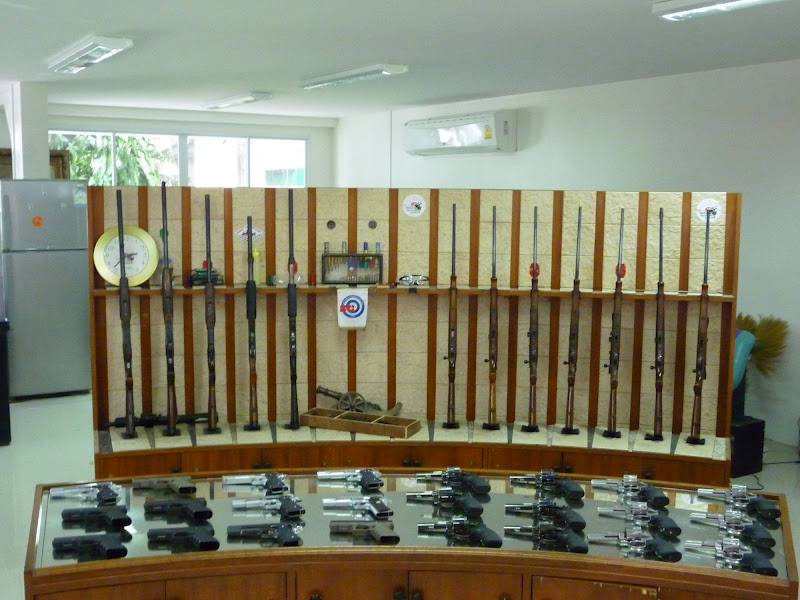
to the Phuket Shooting Range &
Activities Centre. This recreation centre offers a wide range of activities,
such as Go-kart, monkey or elephant shows and a shooting range. We toured round
the shooting range but sad to say, we were only there to explore the
facilities, but not to play. I shall try it the next time I visit Phuket.
| The Shooting Range |
| Are you ready for a game? |
| Arrow shooting |
| Put on these ear muffs and get ready for a shoot! |
The last stop of the day was Laem Promthep, a picturesque viewpoint at the
southern tip of Phuket. According to Cat, that was the best place to catch the sunset.
However, soon after we reached the cape, it started to pour suddenly and all of
us rushed back to the minibus for cover.
After
the brief stop at Laem Promthep, we headed back to the resort. We were given
1.5 hours to rest before heading out for dinner at Merlyn Beach Resort. Being
my first trip to Phuket, not one minute was to be wasted, hence, I took a walk down
to Patong Beach, which was a mere 5 minutes
away. Once there, the sight of tourists reclining on deck chairs greeted me. There
were also others playing water sports and beach balls. While enjoying the sound
of the waves on the beach, I was momentarily distracted by some screaming in
the distance. I lifted up my head in the direction of the screams and saw that
there were people parasailing, ‘flying’ high up in the sky!
| Relaxing on the deck chairs at Patong Beach |
| Jet-skiing, the water sport that I have always wanted to try |
| The bustling road with many tourists |
| Cute signage warning about drunken people crossing the road |
DAY 2. It’s time to get some work done today. ¾
of the day had been allocated for the Andaman
Travel Trade Show, a buyers-meet-sellers session held at the Rajahbat
University Convention Hall. Notwithstanding, we managed to find time for
shopping after the trade fair at the Phuket
Premium Outlet. The weather was unpredictable though, as it started to pour
when we reached there. Rainy weather did spoil the fun of shopping, especially
when the walkways weren’t sheltered, but that did not deter us from some
serious card swiping. It was indeed a challenge to move from one store to
another, but almost everyone came back with a bundle of shopping bags and big
wide smiles.
| Phuket Premium Outlet |
| Shopping is my greatest love |
DAY
3. A conversation on Phuket never deviates from the
sun, the sand and the sea. Apart from the main island of Phuket, there are many
other small islands surrounding Phuket, each with its own attractiveness. The
island of Koh Khai was where we
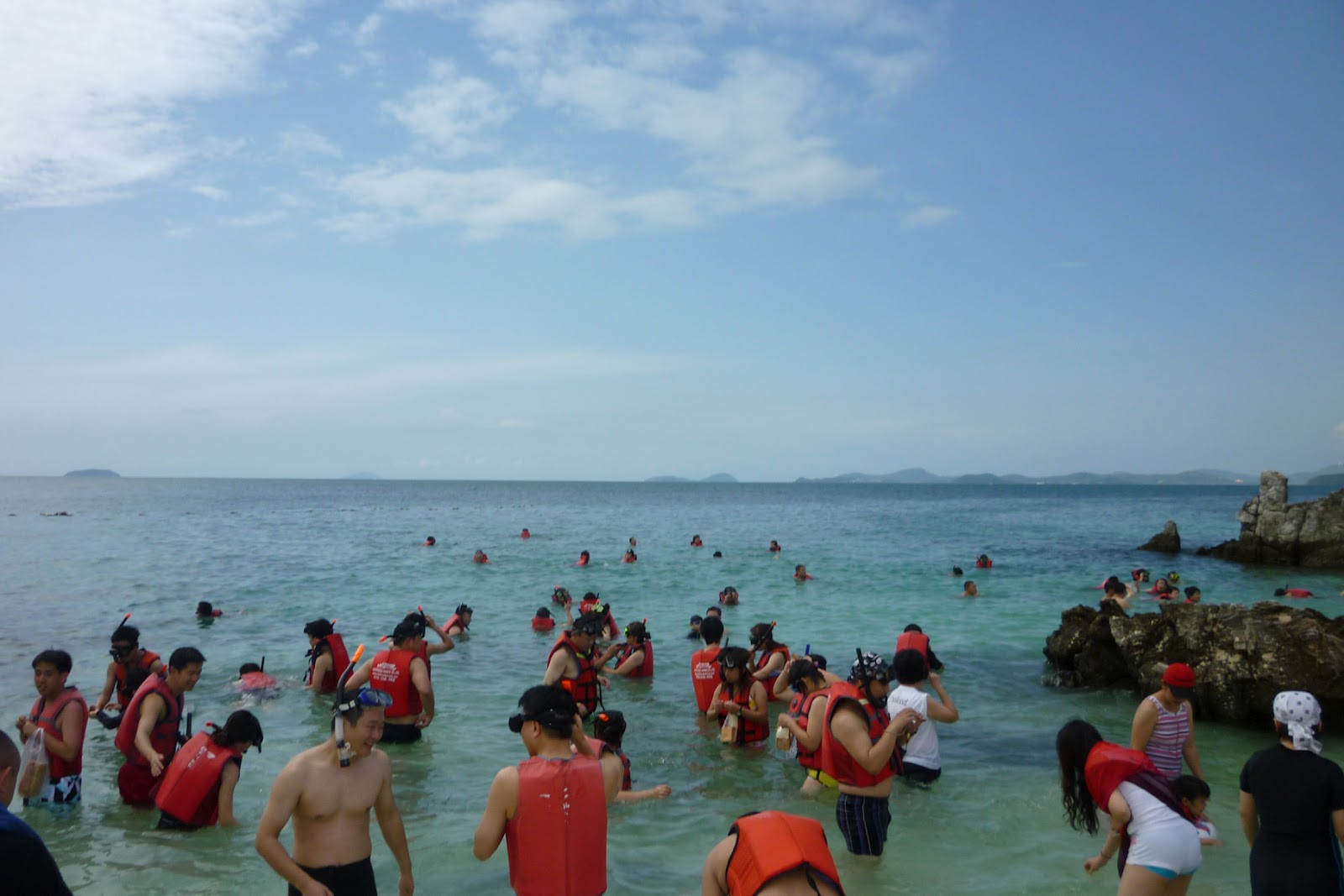
headed out for early in the morning. Our means of transport: a 20-minute
speedboat ride from the main shore. The journey to Koh Khai is an adventure in
itself, with the boat rocking vigorously due to the high tide. It was as if we
were taking a roller-coaster ride at a theme park, albeit on water. Adventure
soon gave way to excitement as the sandy beach came into view. As soon as we
alighted from the boat, we parked our belongings on the deck chairs reserved
for us, and went snorkeling in the crystal clear waters. I had always wanted to
try snorkeling and now was the chance! I had great fun despite the fear of
water. It was a beautiful experience getting up close with the fishes and
corals and being surrounded by all the colorful fishes. We also brought some
bread to feed the fishes and the more we fed, the larger the number of fishes
that surrounded us! I would call these fish ‘Happy Fish’ with their endless supply
of food from the tourists, won’t you agree? After swimming with the fishes, I
took a break and relaxed on the deck chair, enjoyed the windy breeze and the warm
sun.
| Koh Khai Island |
| Fun time feeding the fish |
| The soft sandy beaches of Koh Khai |
Everyone felt tired when we got back
from Koh Khai island, so it was a godsend when we were offered a complimentary
spa at the Rarinjinda Wellness Spa .
A big ‘Thank You’ to the organizer of this trip for that! The spa was
conveniently located adjacent to the back of Jungceylon Shopping Centre. Its services and facilities
included foot massage, body massage, facial, colon cleansing and detoxifying
infrared sauna. We chose to take up the aromatherapy oil massage. The therapist
was really good and the massage was excellent and very relaxing. I felt so refreshed
and rejuvenated after the massage.
After
sundown, we went to Phuket FantaSea,
located on Kamala Beach. Phuket FantaSea is a 140-arce entertainment theme park
showcasing the charm and beauty of Thailand and its rich traditional culture.
When I entered the theme park, it seemed as if the clock had been rewound. The games
at the theme park reminded me of the Uncle Ringo Amusement Park back in
Singapore. It was like an old-school fun fair where you’d find games like throwing
a ball to hit the cans placed a distance away. And the prize: cuddly soft toys
that come in various shapes and sizes, just like the good old days. However, there
are no adventurous or adrenaline-pumping roller-coaster rides of the modern
world here so don’t get your expectations up too high when you hear the words ‘theme
park’.
We had
dinner at Golden Kinnaree, one of
the restaurants in Phuket FantaSea offering Thai and International buffet. When
I walked into the restaurant, my jaws dropped. The restaurant was majestically huge,
with a seating capacity of up to 4000, and it shimmered in gold with its
exquisite and intricate architecture. After the buffet dinner, we took a stroll
around the park. The park turned into a mini Carnival Village at night with performances
and souvenir stores. One of the attractions – Tiger Jungle Adventure – awed me
with the animals I saw in there. Walking through a magical adventure and
catching glimpses of exotic animals right in your face, it really made me
wonder if the animals were real. This enchanting wonderland also boasts of the
white tigers living in the grand white palace. After visiting the white tigers and
some photo-taking around the park, we made our way to the much-anticipated theatrical
performance, the main highlight of the theme park. The rules were strict here:
the gate only opens at 8:30pm and we were required to surrender our handphones
and cameras as recording or photo-taking of the show was not allowed. The
performance was overwhelming, to say the least. The daring stunts, magical
illusions, acrobatics, special effects and much more had the audience
transfixed. What amazed me most were the animal performances, and I was even
startled by the elephant show! The elephants, birds, chickens and goats all
seemed to know how to do the tricks, and knew where to enter and exit the stage,
just like a human performer. It totally left us wanting for more when it ended.
| Entrance of Phuket FantaSea |
| Welcome to wonderland! |
| The main stage at Carnival Village |
| The majestic, shimmering Golden Kinnaree |
| Are the animals real? |
| White tigers living in the majestic kingdom |
| All ready for some spectacular performance |
DAY
4. My last day in Phuket. The morning would be spent
tidying up work-related matters and after lunch, we would have some free time
for more shopping. Junggeylon, the
shopping mall with more than 200 stores, is a place where you can find almost
everything you need. I simply love shopping in the hypermarket, Big C, for
candies and food stuff for my dog. Besides this huge shopping complex, there were
also a number of shopping bazaars across the road, where I bought most of my
spoils. We checked out of the resort at around 4:30pm and headed to the airport
for our flight back to Singapore. Goodbye, Phuket!
Labels:
Culture,
Phuket,
Sand and Sea,
South East Asia,
Thailand
Subscribe to:
Posts (Atom)